Low-Altitude Emergency Response: Drones for Disaster Relief and Rescue
company news
2026-07-10 18:23:57

SAR drones aren't a replacement for traditional rescue forces—they are their vanguard. During critical windows when ground access is compromised, they establish a highly mobile, cost-effective aerial corridor to save lives when minutes matter.
01 Disaster Response Needs More Efficient Low-Altitude Aerial Capabilities
In recent years, floods, earthquakes, landslides, wildfires, and hazardous chemical incidents have occurred with increasing frequency. The more complex the scene, the more traditional rescue operations tend to run into the same constraints: roads are cut off and responders cannot reach the frontline; communications are limited and disaster conditions are difficult to verify in time; rising water levels or fragmented terrain sharply reduce the efficiency of supply transport. During flood rescue operations in Hengzhou, Guangxi, public reports showed that some affected villages temporarily faced cut-off roads, internet, power, and water. While rescue teams kept waterborne routes running, they also opened an aerial supply channel, with multiple drones relaying drinking water, dry food, and other essential supplies to trapped areas.
Scenes like these make the value of drones clearer: a rescue drone is not meant to replace every ground or waterborne rescue force. Its role is to rapidly establish a low-cost, highly mobile, and highly efficient aerial corridor during the critical window when ground access is blocked and every minute matters.
02 R&D Origin: Built from Real Emergency Response Sites
For ZHTAero, emergency rescue is not an application scenario that stays at the concept stage. It is a technical conviction shaped by the founding team's long-term participation in major, complex response operations. At the end of April 2015, after the sudden 8.1-magnitude earthquake in Nepal, the founding team worked with the Gold Force of the Chinese People’s Armed Police Force(PAP Gold Force, now renamed as Natural Resources Comprehensive Survey Command Center, China Geological Survey ) on the frontline, using fixed-wing and multirotor UAVs for real-time aerial imaging and surveying, terrain reconnaissance, and large-scale checks of secondary hazards, providing critical data for emergency decision-making.


In August 2015, during the response to the Tianjin Port explosion, the team supported onsite forces with fire-source reconnaissance, toxic smoke measurement, and 3D modeling. After completing that mission, the team moved on to the landslide site in Shanyang, Shaanxi, to conduct disaster monitoring.

These missions repeatedly proved one thing: what rescue sites need most is not merely a drone that can fly, but an industrial-grade UAV platform that can be deployed rapidly in complex environments, operate with stability, adapt to multiple tasks, and genuinely become part of the rescue workflow.
03 From Field Experience to Product R&D: Emergency Applications of the KEEL Series Drones
Major emergency response sites keep raising three core questions:
First, can we assess the disaster situation more quickly?
Second, can we prioritize the delivery of urgently needed supplies?
Third, can we maintain a continuous supply chain before roads are restored?
From "seeing the scene" to "reaching the scene," from "the first wave of supplies" to "continuous transport," what ZHTAero aims to provide is not a single aircraft, but a coordinated low-altitude emergency response capability that can be deployed by rescue phase.
Low-Altitude Situational Awareness: KEEL Long-Endurance, Long-Range Modular UAV
At flood, earthquake, and landslide disaster sites, rescue commanders first need to know: where are the people, where are the roads broken, where are rivers overflowing, where can aircraft take off and land, and which areas need priority support? KEEL drone turns "being able to see the scene" into "being able to see it continuously." With up to 160 minutes of unloaded endurance, a maximum horizontal speed of 30 m/s, and a maximum payload of 10 kg, it is well suited for wide-area patrol, disaster assessment, trapped-location confirmation, road-disruption verification, and real-time situational awareness.
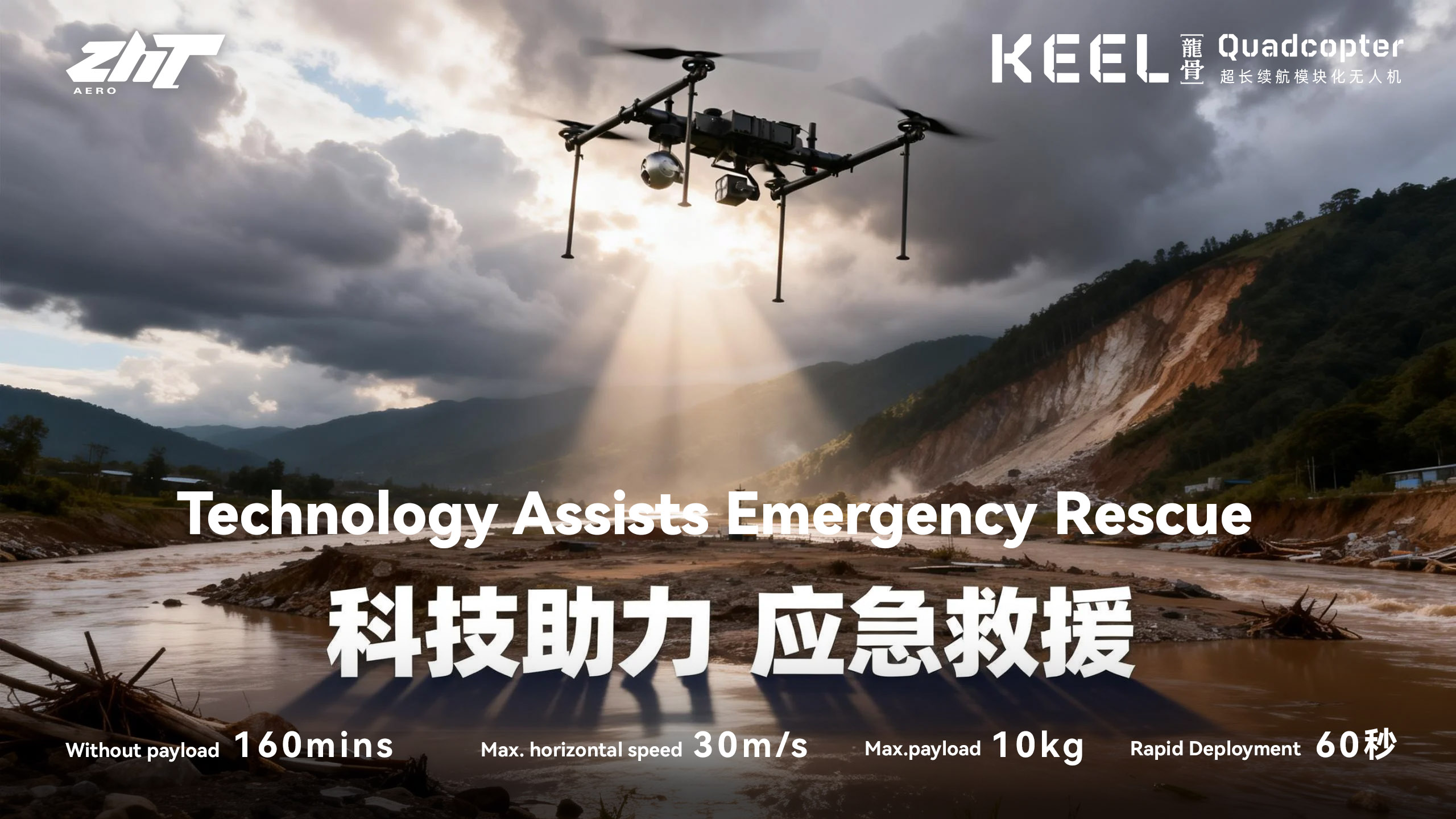
Integrated with payloads such as a tri-sensor gimbal, searchlight, loudspeaker, and cargo box, KEEL can extend daytime patrol into night search, auxiliary lighting, onsite voice broadcasting, and lightweight supply delivery, forming a multi-mission low-altitude sensing platform.
Key Features: Long endurance: 30-160 min, suitable for sustained wide-area patrols
High efficiency: 30 m/s, reaching priority areas quickly. Multi-payload compatibility: up to 10 kg, supporting reconnaissance, lighting, voice broadcasting, delivery, and other mission equipment
Rapid deployment: the complete aircraft can be deployed by one person in as little as one minute for immediate operation
Rapid Emergency Delivery: KEEL MINI High-Speed Response Platform
In flood rescue scenarios like Hengzhou, Guangxi, the first wave of demand is often not "large and complete," but "light and urgent": drinking water, dry food, medicine, emergency communication devices, rescue ropes, and more.
KEEL MINI drone is built precisely for this kind of time-critical mission. It offers a maximum payload of 8 kg and a maximum speed of 40 m/s, supports rapid single-person deployment, has a symmetrical wheelbase of only 906 mm, and can safely take off and land within a 2-meter-diameter area. By breaking through terrain constraints, it is ideal for small-batch, high-frequency, point-to-point emergency delivery.
With payloads such as an aerial release device, aerial winch, and micro gimbal, KEEL MINI can create a closed loop around "onsite identification, rapid approach, precise airdrop, and low-altitude hoisting." It does not replace ground rescue; before roads are reopened, it helps secure the first critical supplies for trapped locations.
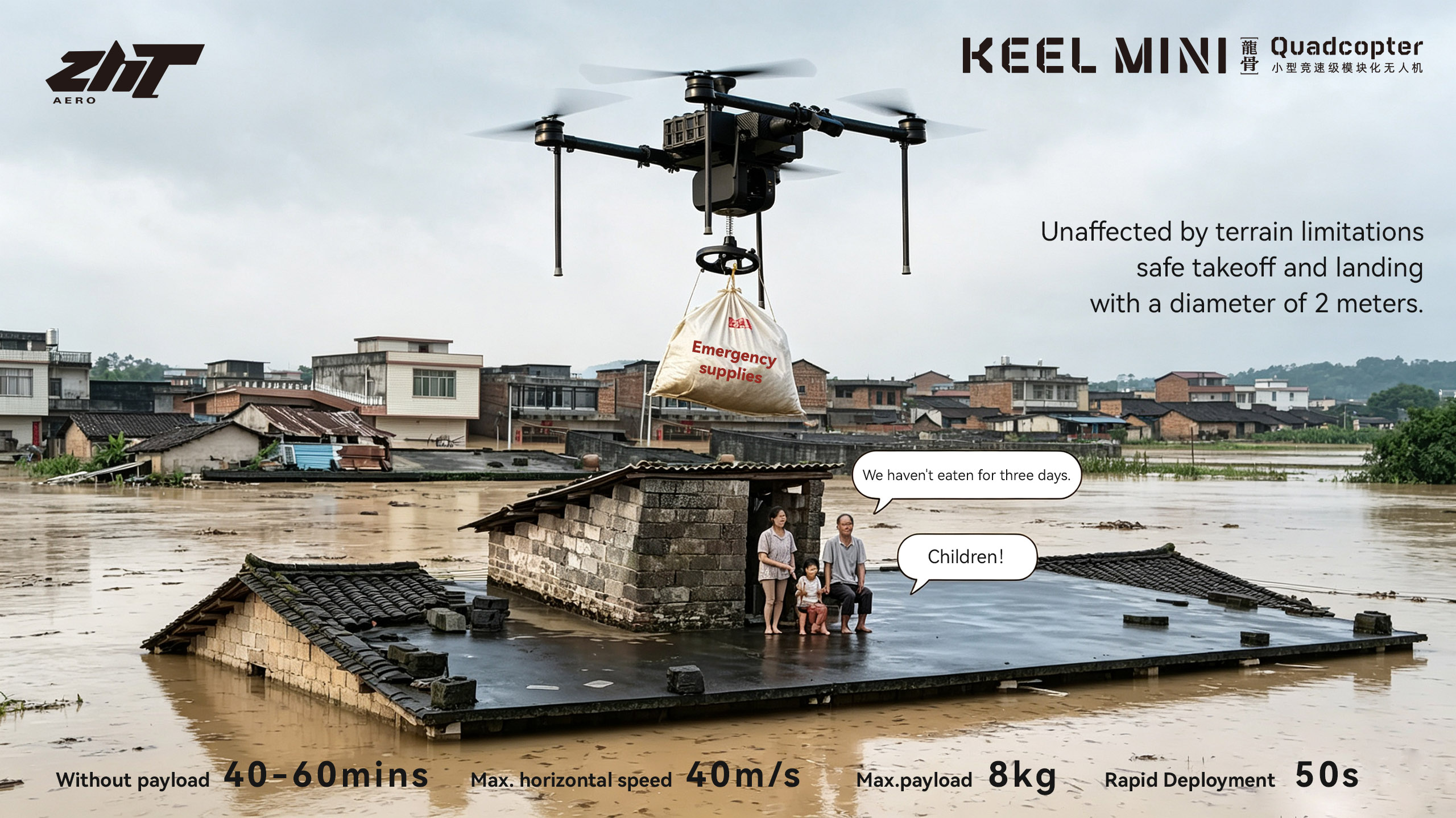
Key Features: Ultra-fast response: 40 m/s
Maximum instantaneous speed, reducing time to arrival
Lightweight delivery: 8 kg maximum payload, covering urgent supplies such as drinking water, food, and medicine
Rapid deployment: single-person operation, suitable for fast setup in complex disaster sites
Heavy-Lift Continuous Support: KEEL MAX Large-Payload Aerial Transport Platform
During the recent flooding in Guangxi, many areas became isolated islands in the water, with residents trapped. Drone pilots from across the region spontaneously assembled and rushed to the frontline from every direction. In normal times, they work across industries such as industrial lifting, agriculture, forestry, and plant protection; in a crisis, they quickly changed roles and put their operational equipment directly into emergency rescue.
"Hang in there, folks! I'm coming with the drone!" Rescue teams operated heavy-lift drones to complete multiple personnel transfers and could even hoist rescuers across floodwaters, delivering them precisely to trapped residents. "In principle, drones are not permitted to carry people, but in this moment, people come before protocol." That is technology at its most moving, and it also validates the "peacetime-to-emergency dual-use" value of heavy-lift industrial drones.
With a maximum payload of 200 kg and a symmetrical wheelbase of about 2 meters, KEEL MAX drone can establish aerial transport routes between school playgrounds, factory open spaces, village high ground, and temporary assembly points, carrying batches of drinking water, food, medicine, emergency power supplies, communication equipment, and rescue gear.
Leveraging the excellent off-road performance of ground pickup trucks, the drone can be transported by pickup truck to the nearest safe zone close to the disaster site. With a 15-minute endurance at full load, KEEL MAX can deliver more supplies to more distant and isolated affected communities.
KEEL MAX can also work with boats to form a complementary transport system of "bulk transfer + precision delivery": powered boats handle centralized transport of large quantities of daily necessities and rescue equipment, as well as mass evacuation of trapped residents, providing heavy-lift support along main routes; KEEL MAX targets places that boats struggle to reach, such as shallow-water zones, narrow lanes, and scattered trapped locations, and precisely airdrops first-aid medicine, emergency food, and lifesaving equipment to fill the last-mile rescue capacity gap.
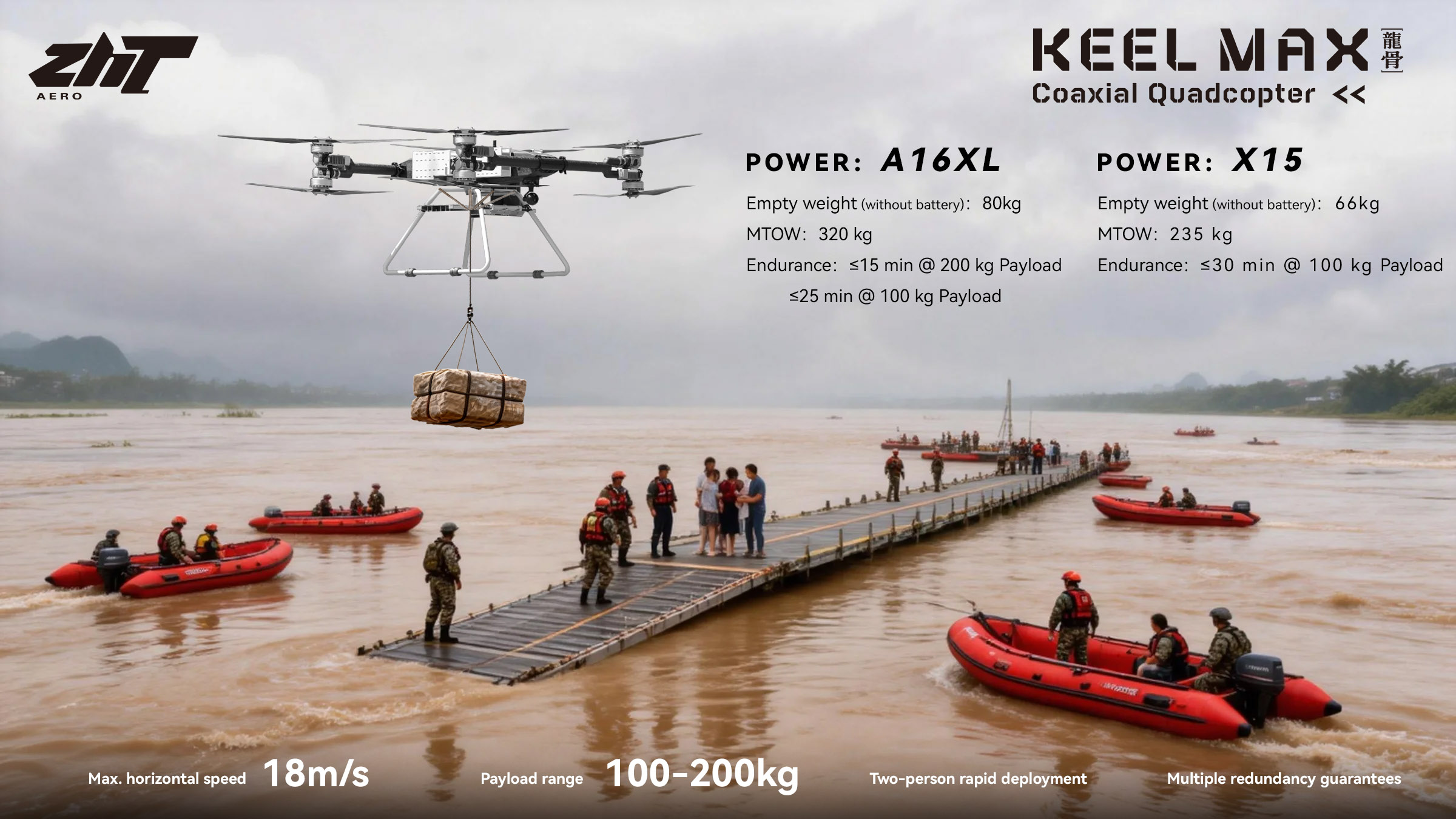
Rescue helicopters rely on dedicated takeoff and landing sites, professional maintenance crews, and complex airspace coordination, and they are difficult to deploy close to the frontline after disaster-area roads are damaged. KEEL MAX uses a modular quick-release design and can be assembled and deployed by only 1-2 people, without a paved runway or dedicated airport. It compresses emergency response time from hours to minutes, making it especially suitable for sudden disasters with extremely short rescue windows.

Key Features:
Heavy-lift transport: maximum payload of 200 kg for batch material delivery
Short-range efficiency: 15 min endurance at full load, suitable for high-frequency shuttles between temporary takeoff and landing points
Continuous support: covers daily necessities, emergency power supplies, communication equipment, and rescue gear
Modular design: smaller footprint than traditional drones, faster deployment efficiency
In recent years, heavy-payload drones have been used more and more often in disaster relief. At higher altitudes, helicopters serve as the main force for difficult missions; at low altitude, KEEL MAX fills blind spots and reaches targets with precision. Together, they build a three-dimensional aerial rescue network, where different equipment carries the same commitment to saving lives.
Looking ahead, heavy-lift drones are bound to become more deeply integrated into emergency rescue systems and unified airspace management. Mission areas can be planned and coordinated in real time through ground command systems. Helicopters can handle aerial trunk routes, while drones handle low-altitude last-mile emergency response. Operating at different altitudes, along different routes, and within different time windows, the two can make the disaster relief chain more continuous and safer.
04 Making Technology Truly Reach the Scene When It Matters Most
Thousands of years ago, humanity placed its hope of overcoming floods in myth: the East envisioned Nuwa repairing the sky to save mankind, while the West showed early wisdom with the dove seeking dry land from Noah's Ark. Today, Chinese technology is turning this shared aspiration across civilizations into reality. What remains unchanged is humanity's courage, wisdom, and mutual aid in the face of disaster.
When flood season arrives, response becomes a command, and low-altitude technology must shoulder its responsibility. With the core advantages of low cost, high mobility, and high efficiency, drones support rescue decision-making and livelihood protection across the full chain. Each aerial lifeline that opens is another validation of the value of low-altitude equipment and a vivid expression of the principle of putting people first. Behind every timely arrival from the sky and every takeoff against the wind are not only the responsibility and courage of frontline drone pilots, but also the perseverance and commitment of Chinese technology companies that continue to deepen their innovation. ZHT Aero remains committed to innovation as its core, making technology a solid aerial force for emergency rescue, so that every takeoff carries hope to its destination.
We salute every drone pilot who moves toward danger, and we sincerely hope the floods recede soon and all affected communities pass through this crisis safely.

Contact Us

Tel: +86-18526324382
E-mail: info@zhtaero.com
Add.:Tianjin University Innovation Research Institute,
Balital Industrial Park, Jinnan District, Tianjin, China
Balital Industrial Park, Jinnan District, Tianjin, China
Add.:Kerry Center, Qianhai, Shenzhen, Guangdong
Drone System
Service and Support
Copyright © 2026 ZHT Technology Co., Ltd.